
<?xml version="1.0" encoding="UTF-8"?><profile href="/about_us/FacultyDirectory/MicrobiologyBiochemistryImmunology/MingliLiu/index.php">
   <image><img src="/_resources/MSMimages/FacultyDirectoryImages/MBI/MingliLiu_23.JPG" alt="Dr. Mingli Liu"></img></image>
   <name>Mingli Liu, MD, PhD, MSCR</name>
   <title>Associate Professor</title>
   <department>Microbiology, Biochemistry &amp; Immunology</department>
   <email>mliu@msm.edu</email>
   <title2></title2>
   <department2></department2>
   <phone>(404) 752-1850</phone>
   <location>Medical Education Building | MEB C-316</location>
   <education>
      <p style="font-weight: 400;"><strong>GRADUATE<br></br></strong>Peking Union Medical College &amp; Tokyo University<br></br><strong>Degree: </strong>Doctor of Philosophy in Hematology/Oncology </p>
      <p style="font-weight: 400;"><br></br>People’s Liberation Army Postgraduate Medical School<br></br><strong>Degree: </strong>Master of Science in Hematology/Oncology</p>
      <p style="font-weight: 400;"><br></br>Morehouse School of Medicine<br></br><strong>Degree: </strong>Master of Science in Clinical Research<br></br><br></br><strong>MEDICAL SCHOOL<br></br></strong>Peking University School of Medicine<br></br><strong>Degree:<span> </span></strong>Doctor of Medicine</p>
      <p style="font-weight: 400;"><strong><br></br>POSTGRADUATE<br></br></strong>Thomas Jefferson University, Kimmel Cancer Center</p>
      <p style="font-weight: 400;">University of Miami Miller School of Medicine</p>
      <p style="font-weight: 400;"><strong> </strong></p>
   </education>
   <research>
      <p><strong>Molecular pathways and therapeutic targets in brain tumors and cancer stem cells</strong><br></br><br></br></p>
      <p>The Liu lab mainly focuses on researching cell signaling pathways associated with
         brain cancer, especially cell differentiation and tumor progression. The current standard
         of care of surgery and radiochemotherapy for glioblastomas (GBM) is lacking and does
         not result in improved prognosis. Accumulating evidence shows that the failure of
         using current chemo- and radio-therapies to treat GBM and the resultant of high tumor
         recurrence are attributed to the presence of a small subpopulation of glioma stem
         cells (GSC), which is characterized by their stem cell-like properties and aggressive
         behavior.<br></br><br></br></p>
      <p>Our ongoing research projects include: <strong><em><u>1)</u></em></strong> TRPM7 induces tumorigenesis and stemness through Notch and Stat3 activation in glioma.<br></br><br></br><img title="Research Interests" src="/about_us/FacultyDirectory/MicrobiologyBiochemistryImmunology/MingliLiu/ResearchInterests.jpg" alt="Research Interests" width="404" height="357"></img><br></br><br></br>The proposed study will delineate the molecular mechanisms of TRPM7 in the development
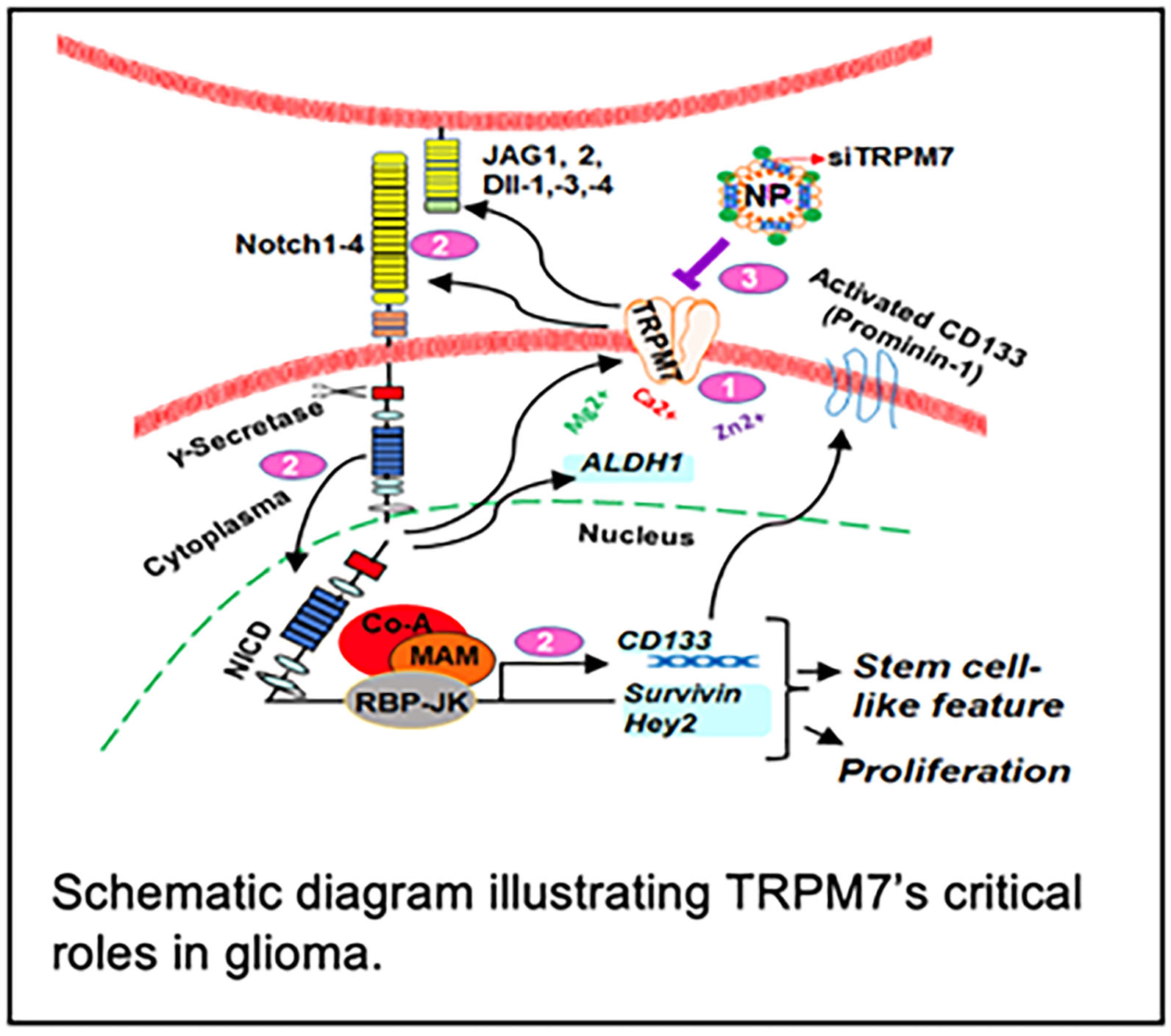
         and progression of glioma tumorigenesis and stemness as well as develop TRPM7 as a
         novel drug target for glioma patients (see schematic figure). <strong><em><u>2)</u></em></strong> Determination of racial disparities in glioma through Rap1b/Notch -induced tumorigenesis
         and stemness. We are the first to report that the suppression of Rap1b inhibits proliferation,
         migration, and invasion of malignant human gliomas, indicating that Rap1b may represent
         a novel and promising target for therapeutic intervention of malignant glioma. The
         proposed study will clarify the predictive role of Rap1b in GBM in patients, reveal
         biological diversity across races and unaddressed health disparities, and evaluate
         Rap1b’s potential as a therapeutic target. <strong><em><u>3)</u></em></strong> Regulation of malignant glioma stem cells through acid sensor ASIC1. The available
         mRNA microarray data from both Rembrandt and TCGA reveal that glioma patients with
         high ASIC1 expression have preferable survival compared to those with low ASIC1 expression,
         meaning that ASIC1 is associated with improved survival rates of glioma patients and
         indicate that preserved susceptibility to extracellular pH may impair tumor growth. This
         study will determine that ASIC1 functions as a tumor suppressor in glioma stemness
         and tumorigenesis while the stimulation of ASIC1 activity may inhibit GSC self-renewal
         and temozolomide induced resistance, and the novel knowledge from this study will
         potentially be used to significantly impact the outcome of glioma patients' treatments
         and contribute to ion transport proteins studies in other cancers. <strong><em><u>4) </u></em></strong>Regulation of self-renewal and differentiation of neural stem cells by ASIC1a signaling.
         Our overall hypothesis is that ASIC1a is functionally connected to neural differentiation
         of neural stem cells (NSC) through the Notch signaling pathway. In this project, we
         will determine ASIC1a’s regulation of NSC’s neural differentiation using hiPSC-NSCs
         and ASIC1a depleted cells from ASIC1a knockout mice (ASIC1a-/-).<br></br><br></br></p>
      <p>The overall goal is to better understand and develop mechanism-driven targeted therapies
         for brain cancer patients. These include identification and characterization of genetic
         and epigenetic changes during the initiation and progression of brain tumor, functional
         characterization of these genes and/or proteins in cancer initiation, and development
         of targeted therapies.<br></br><br></br></p>
      <p>The Liu lab currently has positions open for postdoctoral candidates and interested
         students learners for short- or long-term research experiences. Please contact Dr.
         Liu at <a href="mailto:mliu@msm.edu">mliu@msm.edu</a> for more information.<br></br><br></br></p>
      <p><strong>Current Personnel</strong></p>
      <ul>
         <li><a href="mailto:vramar@msm.edu?subject=">Vanajothi Ramar</a>, PhD, Instructor</li>
         <li><a href="mailto:rajsidhu@msm.edu?subject=">Rajveer Singh Sidhu</a>, PhD, Postdoctoral Fellow</li>
      </ul>
   </research>
   <boardcerts></boardcerts>
   <publications>
      <ul>
         <li>
            <div>Sidhu RS, Ramar V, Safir T, Jones T, Guo S, Wang G, Liu M. Rap1b promotes glioma growth
               and stemness via regulation of Notch1 and VEGFR2 signaling pathways. Cell Signal.
               2026 Jul;143:112457. doi: 10.1016/j.cellsig.2026.112457. Epub 2026 Mar 2. PubMed PMID:
               41780809; NIHMSID:NIHMS2154942.<br></br><br></br></div>
            <div>•<span class="Apple-tab-span"></span>Ramar V, Sidhu RS, Pako O, Cisse CR, Guo AA, Li J, Stapleton K, Guo S, Wang G, Liu
               M. TRIM21 functions as an oncogene in glioblastoma by transactivating FOSL1 and promoting
               the ubiquitination of p27. Cell Commun Signal. 2025 Jul 1;23(1):313. doi: 10.1186/s12964-025-02325-6.
               PubMed PMID: 40598282; PubMed Central PMCID: PMC12211012.<br></br><br></br></div>
            <div>•<span class="Apple-tab-span"></span>Guo S, Sidhu R, Ramar V, Guo AA, Wang G, Liu M. RNA Sequencing Identifies Novel Signaling
               Pathways and Potential Drug Target Genes Induced by FOSL1 in Glioma Progression and
               Stemness. 2025;19:157-176. doi: 10.2147/BTT.S509774. eCollection 2025. PubMed PMID:
               40206361; PubMed Central PMCID: PMC11980931.<br></br><br></br></div>
            <div>•<span class="Apple-tab-span"></span>Ramar V, Guo S, Hudson B, Khedri A, Guo AA, Li J, Liu M. Interaction of NF-κB and
               FOSL1 drives glioma stemness. Cell Mol Life Sci. 2024 Jun 10;81(1):255. doi: 10.1007/s00018-024-05293-1.
               PubMed PMID: 38856747; PubMed Central PMCID: PMC11335291.<br></br><br></br></div>
            <div>•<span class="Apple-tab-span"></span>Guo S, Ramar V, Guo AA, Saafir T, Akpobiyeri H, Hudson B, Li J, Liu M. TRPM7 transactivates
               the FOSL1 gene through STAT3 and enhances glioma stemness. Cell Mol Life Sci. 2023
               Aug 29;80(9):270. doi: 10.1007/s00018-023-04921-6. PubMed PMID: 37642779; PubMed Central
               PMCID: PMC10465393.</div>
            <div> </div>
            <div>  The website UR:   My Bibliography - NCBI</div>
            Click <a href="https://www.ncbi.nlm.nih.gov/myncbi/mingli.liu.2/bibliography/public/" target="_blank" rel="noopener">here</a> to view additional publications.</li>
      </ul>
      <p> </p>
   </publications>
   <awards>
      <ul>
         <li><span>2009 Patent, Technology Transfer, ID: UMG-105, A Novel GREB1 Monoclonal Antibody,
               University of Miami</span></li>
         <li>2016-2017 Minority-Serving Institution Faculty Scholar Award, American Association
            of Cancer Research<span></span></li>
         <li><span>2016 Minority-Serving Institution Faculty Scholar Award, American Association of Cancer
               Research</span></li>
         <li><span>2016 Health Disparity Research Training Program Award, The University of Alabama at
               Birmingham</span></li>
         <li><span>2016 Pittsburgh Intensive Training in Hematology Research Scholarship, University
               of Pittsburgh</span></li>
         <li><span>2016 Faculty Development Program, Morehouse School of Medicine</span></li>
         <li><span>2017-2019 Scholar of the Clinical Research Education and Career Development, Morehouse
               School of Medicine</span></li>
         <li><span>2018 Scholar of Frontiers in Stem Cells in Cancer, NIH/University of Pittsburgh</span></li>
         <li><span>2019-2020 TxTM Pilot Grant Award, Morehouse School of Medicine</span></li>
         <li><span>2021 NIH/Ad hoc reviewer, Clinical Neuroimmunology and Brain Tumors Study Section</span></li>
         <li><span>2021 NIH/Ad hoc reviewer, Glioma, Multiple Sclerosis, and Neuroinflammation Study
               Section</span></li>
         <li><span>2021 NIH/Ad hoc reviewer, Cancer Therapeutics and Drug Development Study Section</span></li>
         <li><span><span><span>2023 N</span></span></span>IH/Ad hoc reviewer, SuRE Program (R16), Special Emphasis Panel</li>
         <li>2023 NIH/Ad hoc reviewer, ZTR1 RD-08 Understudied Proteins Associated with Rare Disease
            (R03)</li>
         <li>2023-2025 NIH/Ad hoc reviewer, SuRE/SuRE First Program (R16), Study Sections (on 3
            separate occasions)</li>
         <li>2025 NIH/Ad hoc reviewer, SBIR/STTR Study Section</li>
         <li><span>2026 NIH/Ad hoc reviewer, Clinical Neuroimmunology and Brain Tumors (CNBT) Study Section-
               </span></li>
         <li><span>2026 NIH/Ad hoc reviewer, Translational Cancer Research SPORE P50 ZRG1 BTC-A (41)
               </span></li>
         <li><span>2026 NIH/Ad hoc reviewer, Cancer Therapeutics, ZRG1 ACT-P (81) S</span></li>
      </ul>
   </awards>
</profile>